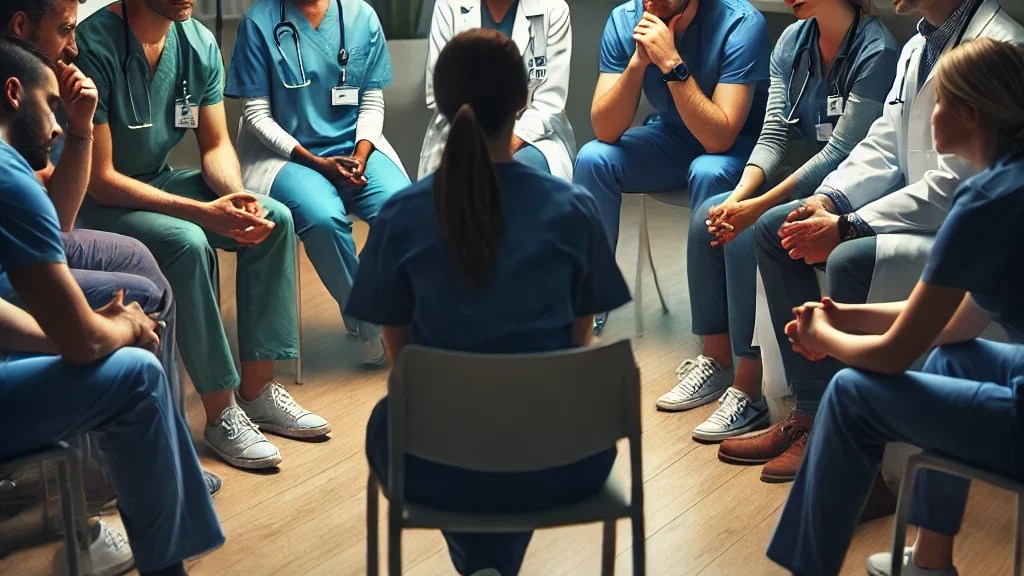
In clinical practice, things rarely go as planned. So why do we train students like they always will?
I recently read a fascinating article by Amorøe et al. (2025) identifying tangible debriefing techniques to enhance learner appreciation of overcoming challenges within simulation activities, and it’s inspired me…
Amorøe et al., utilise Hollnagel’s (2014) theory of safety-I vs safety-II (which I’ve summarised below) to demonstrate how asking ‘what went well’ or ‘what could be improved’ is a restrictive form of debriefing and directs the students to focus on preventing things going wrong (safety-I). Whereas if we support learners to acknowledge challenges (not improvement needs) and how to overcome those (not what to do next time) we’re increasing their resilience and critical thought (safety-II).
| Safety-I | Safety-II |
| Focuses on what went wrong | Focuses on successes/contributions to success |
| Aims to prevent errors/failures | Aims to understand and reinforce successful performance |
| Views safety as absence of negative outcomes | Views safety as presence of adaptive capacity |
| Investigates incidents and deviations | Investigates everyday performance and adjustments |
Amorøe et al’s discussion points inspired me to consider these 3 key actions in my future debriefs:
- Use the terms ‘contributions to success’ and ‘challenges’ rather than ‘what went well or what to improve’.
- While I don’t think I’ve been guilty of the latter, I’m now mindful that it incites a fearful culture of right/wrong actions in healthcare, completely missing the complexity in almost every situation.
- Be comfortable probing for concrete answers.
- I’m getting better at this with each debrief but if we leave ambiguity in the debriefing room, the students haven’t made sense of the scenario. Was the debrief effective given this? I’m confident at probing for clarity – ‘can you elaborate please?’ is my favourite response now, getting students to really consider their explanation at a granular level.
- Return to the respondent.
- A technique I’d not actually considered, the discussion here is opening a theme, receiving a response, opening to the group and then returning to the original responder to gauge the reflection on peer comments. I think this is a really rich opportunity to capture meaningful learning happening live and promote a culture of peer support.
While I’m discussing this in the same context as Amorøe et al’s pre-registration learner setting, I think there’s some really meaningful insights across the healthcare education fields. I’m really interested to see the student’s response to my resilience-focused debriefs!
Amorøe, T.N., Rystedt, H., Oxelmark, L., Dieckmann, P. and Andréll, P. (2025) Resilience-focused debriefing: addressing complexity in interprofessional simulation-based education—a design-based research study. Advances in Simulation, 10(1) 25. Available from: https://doi.org/10.1186/s41077-025-00352-4
Hollnagel, E. (2018) Safety-I and Safety-II: The Past and Future of Safety Management. London: CRC Press. Available from: https://doi.org/10.1201/9781315607511

 Dean Walker